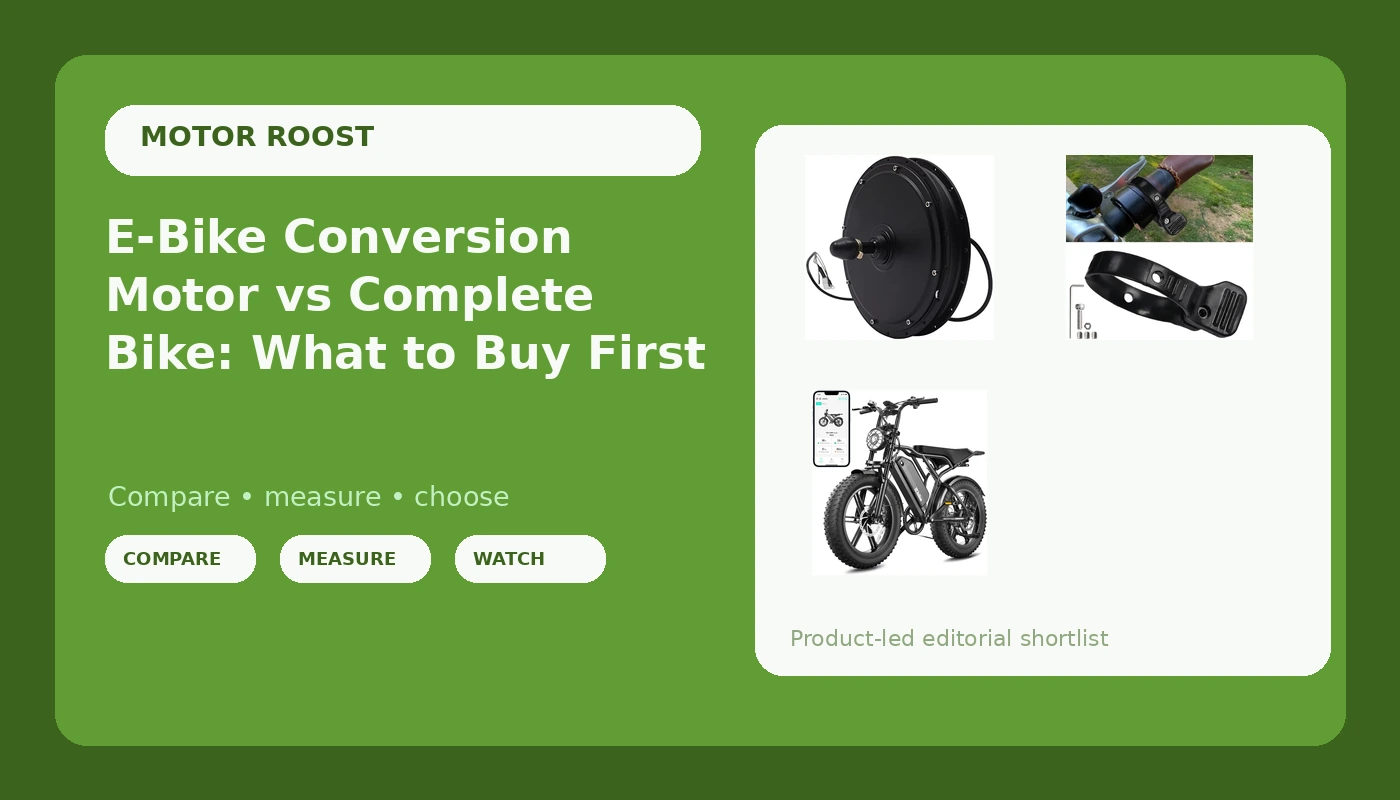
Most people shopping for an e-bike conversion motor are really asking a different question underneath: should I motorize the bike already hanging in my garage, or buy a complete bike and skip the build entirely? That question gets muddier the moment you start reading listings, because a search for e-bike parts throws a 48V hub motor, a small throttle adapter, and a finished fat tire e-bike onto the same page as if they were interchangeable. They are not. One is a drivetrain, one is a control part, and one is a whole vehicle with the battery, tires, and frame already sorted out. This guide explains what each of the three options below actually does, what the specs on the labels really tell you, and how to decide which path fits the bike you have and the riding you do.
Related: How to Measure Rear Dropout Spacing Before You Buy a Motor Kit →
Quick answer
The right pick depends entirely on what you already own and how much work you want to do. If you have a solid donor bike with the correct rear dropout spacing, a 48V hub motor kit is the cheapest way to turn it into an electric bike, provided you also have a compatible battery and controller. If you want a finished, rideable machine with the battery, motor, and fat tires already matched, a complete fat tire e-bike is the simpler and lower-risk path. A thumb throttle adapter is neither of those things: it is a small control part for riders who are replacing a broken throttle or changing the shape of the one they have.
Three useful options
| Model | Best fit | What stands out |
|---|---|---|
| TST Electric Bike for Adults, 48V 15Ah Battery, 1500W Peak Motor, Fat Tire | Riders who want a finished bike with no sourcing or wiring | Complete bike with a 48V 15Ah battery, 1500W peak motor, and fat tires |
| 1000W Ebike Motor Mid Drive Motor Wheel Hub Motor 48V Electric Bike 38-55km/h Rear Wheel Hub Motors fits for The Rear Wheels of Bicycles with Dropouts of 5.31 " | Owners converting a bike they already like | Rear hub drive unit rated 1000W and 48V, specified for 5.31 inch dropouts |
| Canitu Thumb Throttle Adapter,E-Bike Throttle Adapter Attachment Drive Conversion Kits Replacement for Rad, for Lectric, for Pedego, for Himiway, for Magicycle, for Electric Bike | Replacing or reshaping a throttle on an existing e-bike | Throttle adapter listed as a replacement for several popular e-bike brands |
The complete bike: TST Electric Bike for Adults, 48V 15Ah Battery, 1500W Peak Motor, Fat Tire
The trade-off with a complete bike is that you inherit every decision the manufacturer made. You do not get to pick your own battery cells, your own controller current limit, or your own tires. What you get instead is a machine that has already been assembled and matched, which removes the single biggest failure point in any conversion: parts that do not talk to each other. The 1500W figure here is described as a peak rating, and that word matters, because peak and continuous are not the same number. A complete bike also arrives with brakes, wheels, and a warranty path, which is worth more than it sounds when you are comparing it against a pile of parts.
The drive unit: 1000W Ebike Motor Mid Drive Motor Wheel Hub Motor 48V Electric Bike 38-55km/h Rear Wheel Hub Motors fits for The Rear Wheels of Bicycles with Dropouts of 5.31 "
Read that listing title slowly, because it is a good example of why conversion shopping requires attention. The title uses both "mid drive" and "wheel hub," which are two genuinely different motor layouts, and then specifies dropout spacing, which is a rear hub measurement. The dropout requirement is the concrete, checkable detail, and it is the one that should drive your decision. A 5.31 inch spacing is about 135 mm, which is the common rear dropout width on a huge number of bikes, but "common" is not "yours." Measure before you order. Also note that the advertised speed range describes a system, not a motor in isolation: wheel size, battery voltage, controller current limit, and rider weight all move that number. A hub motor kit is the cheapest route into electric assist, and it is also the route that asks the most of you as a builder.
The control part: Canitu Thumb Throttle Adapter,E-Bike Throttle Adapter Attachment Drive Conversion Kits Replacement for Rad, for Lectric, for Pedego, for Himiway, for Magicycle, for Electric Bike
This is the one people misread most often. A throttle adapter does not add power, does not increase speed, and does not turn a pedal bike into an e-bike on its own. It is a control interface part, and its value is either restoration or ergonomics: a stock throttle breaks, wears out, or simply does not fit your hand well, and you want a thumb-operated replacement instead of a twist grip. The brand list on the listing is a compatibility signal, but it is a starting point, not a guarantee. Before ordering any throttle part, confirm the connector type and the wiring order on your existing setup, because throttle connectors are not standardized across every manufacturer and the wrong pin order can cause problems.
Prices and availability may change. Product images, names, and retailer links must be matched by verified ASIN. Do not state a current price, rating, stock status, or measured result without current evidence.
What 48 volts, 1000 watts, and 1500 peak watts actually mean
Voltage is system pressure and wattage is flow, and mixing the two up is how people end up disappointed. A 48V system is the most common conversion voltage for good reason: there is a deep ecosystem of batteries, controllers, displays, and motors built around it, and both the complete bike and the hub motor here run at that voltage. That means you are shopping in the mainstream of the parts world rather than in an orphan format.
The wattage numbers deserve more suspicion. The hub motor is listed at 1000W. The complete bike is listed at 1500W peak. Those two figures are not directly comparable, because one is labeled as a peak figure and the other is not labeled as peak or continuous at all. Continuous rating is what a motor can do all day without cooking itself; peak rating is a short burst. A motor advertised at 1000W might be a 500W continuous unit with a 1000W burst, or it might genuinely hold 1000W. If the listing does not say, assume the higher number is the optimistic one and plan your expectations around the lower.
Battery capacity works the same way. Amp hours alone tell you nothing useful until you multiply by voltage, because watt hours are the actual energy unit. The complete bike's 48V 15Ah pack comes out to roughly 720 watt hours of nominal capacity. That is a respectable figure for a fat tire bike, and it is also a reminder of why comparing "15Ah" against another bike's "20Ah" is meaningless if the voltages differ. Range is not a spec you can read off a listing. It is the product of watt hours, rider weight, hills, speed, assist level, tire pressure, and temperature, which is why any confident mileage claim on a product page should be treated as a best-case scenario.
Speed ratings have the same problem. The hub motor is listed at 38 to 55 km/h, or roughly 24 to 34 mph. That is a wide band, and the band exists because the number depends on the whole system: wheel diameter, battery state of charge, controller current limit, and how much the rider weighs. If you are a heavier rider or you ride hills, plan for the bottom of the range rather than the top.
Matching a motor to the frame and controls you already have
Conversion compatibility comes down to a small number of measurements, and the most important one is the one printed on the motor listing: dropout spacing. The hub motor here specifies 5.31 inches, which is about 135 mm, the standard rear spacing on a large share of bikes. Pull your rear wheel, put a ruler or calipers across the inside faces of the dropouts, and confirm the number in millimeters before anything else. A few millimeters of difference is the gap between a clean install and a frame you have to spread by hand, which is a job you do not want to improvise on an aluminum frame.
The second check is your battery and controller. A 48V motor needs a 48V battery and a controller that can deliver the current the motor wants. If you are converting a bike that already has a battery, verify its voltage and its continuous discharge rating rather than assuming. The third check is the control interface: do you want pedal assist, a throttle, or both, and does your controller support that combination? This is where a part like a thumb throttle adapter enters the picture, since the throttle is the interface between your hand and whatever controller you end up with.
The fourth check is stopping power. Going from pedal speed to 24 mph or more changes what your brakes are being asked to do, and rim brakes on a heavy converted bike in wet weather are a genuinely different experience than they are at 12 mph. Finally, budget the small parts: torque arms, zip ties, a longer chain or a different freewheel depending on your drivetrain, and the time to route wiring cleanly. The kit price is never the whole cost.
- Measure your rear dropout spacing with the wheel removed, in millimeters, and compare it to the 5.31 inch requirement on the motor listing.
- Confirm the voltage and continuous discharge rating of your battery, and the current limit of your controller, before ordering a motor.
- Decide whether you want pedal assist, throttle only, or both, and confirm your controller and display support that setup.
- Inspect brakes, tires, and frame condition, since a conversion raises the speed your existing components have to handle.
- Add up the small parts and the assembly hours, then compare that total against the price of a complete bike.
Practical guidance before you order anything
- Buy the complete bike if you do not already own a donor bike you like. Sourcing a frame, battery, controller, motor, and display separately almost always costs more than the parts list suggests.
- Buy the hub motor kit if your existing bike is already good where it matters: brakes, wheels, and fit. A conversion makes a good bike better and a bad bike worse.
- Treat a throttle adapter as a repair or ergonomics part, not a performance upgrade. It does not change how much power the bike makes.
- Compare watt hours, not amp hours, when you weigh one battery against another, and compare continuous watts, not peak watts, when you weigh one motor against another.
- Read listing titles critically. Mixed terminology, like a single listing using both mid drive and wheel hub, is common, and the fitment measurements are the details worth trusting.
Which option should you choose?
Choose the TST Electric Bike for Adults, 48V 15Ah Battery, 1500W Peak Motor, Fat Tire when you want a finished machine with the battery, motor, and tires already matched and you would rather ride than build. Choose the 1000W Ebike Motor Mid Drive Motor Wheel Hub Motor 48V Electric Bike 38-55km/h Rear Wheel Hub Motors fits for The Rear Wheels of Bicycles with Dropouts of 5.31 " when you already own a bike worth converting, your dropout spacing matches the listed 5.31 inches, and you are prepared to source a compatible battery and controller. Choose the Canitu Thumb Throttle Adapter,E-Bike Throttle Adapter Attachment Drive Conversion Kits Replacement for Rad, for Lectric, for Pedego, for Himiway, for Magicycle, for Electric Bike when your existing e-bike needs a throttle replaced or reshaped and you have confirmed the connector and wiring match.
The caveat on all three is the same: listings describe intent, not your specific bike. Dropout spacing, connector pinouts, controller current limits, and battery voltage are all things you have to verify on your own machine, because a product page cannot see your frame. None of these listings publishes independent measured range, continuous power, or durability data, so treat any performance figure as a manufacturer claim until you have your own miles on it.
The bottom line
These three products sit at three different points on the same decision. A complete fat tire e-bike is the low-effort path and the one that removes compatibility risk, since every part was chosen to work with every other part. A 48V hub motor is the high-effort, potentially lower-cost path that rewards you for owning a good donor bike and knowing its measurements. A thumb throttle adapter is a five-minute fix for a very specific problem, and it belongs in your cart only if that problem is the one you have. Work backward from your frame, your battery, and your brakes, and the right choice usually stops being ambiguous.